
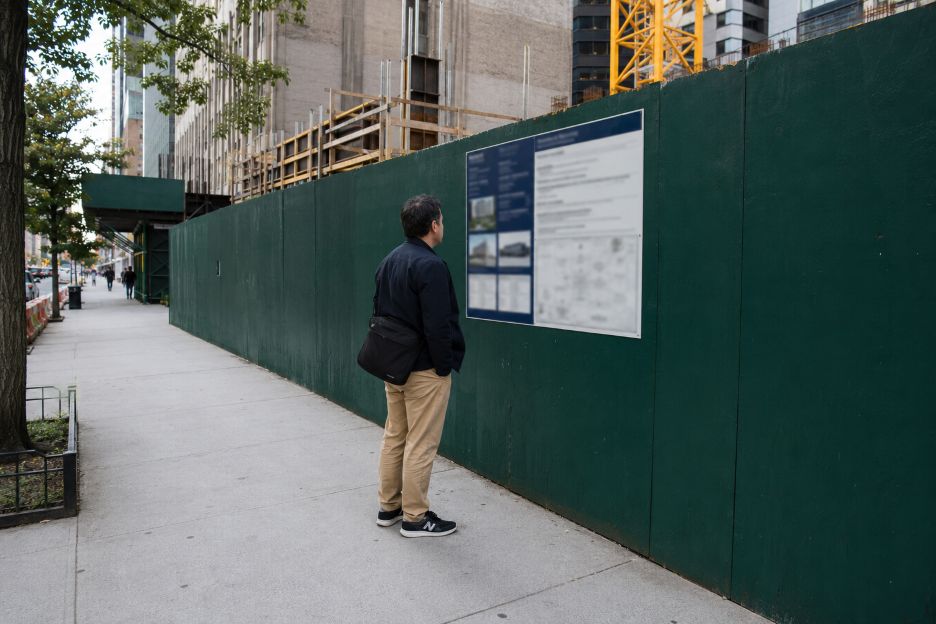
The New York City Department of Buildings requires specific information at permitted construction and demolition sites. Requirements vary with the project and protective structures, but the signs identify the work, show its authorization, name responsible parties, and guide pedestrians. Reading them in the right order turns a crowded fence or sidewalk shed into a useful public record.
Begin at the main frontage. A compliant display may use standardized panels rather than unrelated notices, so examples of construction signs NYC can help readers recognize the category. Still, posted details and official records, rather than appearance alone, determine what a site may do.
Step 1: Find the Project Information Panel
Look for a large panel on a construction fence facing a public thoroughfare. The New York City Department of Buildings says it must use durable, weatherproof, flame-retardant material and sit four feet above grade on each qualifying fence perimeter fronting a public way.
Treat this as the site’s building identification sign. The DOB’s signage update explains that a project panel can show a rendering or zoning diagram, a description of the work, the anticipated completion date, owner and contractor information, 311 information, and the primary permit. Demolition panels do not require a rendering, and some small residential projects are exempt from the full panel requirement.
Start with the address and work description. Terms such as “new building,” “demolition,” “excavation,” or “alteration” show the broad scope. Then note the owner, contractor, completion date, and job or permit number.
Step 2: Check the Permit Posting
Now locate the actual permit. NYC311 explains that plans must be approved before DOB issues a building permit, that the permit must be displayed while work is underway, and that every permit has an expiration date. A posted permit therefore answers a narrower question than the project panel: whether specified work has active departmental authorization.
Read the address, job number, work type, permit holder, and expiration date. Confirm that the address matches and the document appears current. One permit does not necessarily authorize every visible activity. Sidewalk sheds have separate permits, whose identifying information includes permit numbers, expiration dates, and the permit holder’s contact details.
If a date has passed, do not immediately conclude that the project is illegal. Another permit or renewal may cover current work. Record the address and identifying number, then check city records or contact 311.
Step 3: Read Sidewalk Shed Identification
When a sidewalk shed is present, look along its parapet for separate identification. The NYC Department of Buildings sidewalk-shed guidance says it must appear in a central, visible area. Passageways need at least eight feet of clearance, lighting, and unobstructed fire escapes and exits.
This panel tells you who is responsible for the temporary protective structure, while the fence panel describes the larger project. Do not confuse either one with a business sign. City rules generally prohibit advertising on protective structures, although a temporary replacement may be allowed when a shed obscures a lawful existing storefront sign.
Step 4: Follow Directional and Pedestrian Signs
Next, consider movement. Arrows, closure notices, crossing instructions, barricade signs, and marked entrances show safe travel routes. Follow the provided route even if the direct sidewalk appears passable. DOB requires fences to avoid blocking sidewalk access or a building’s means of egress.
Agency responsibility differs by work type. The New York City Department of Transportation says long-duration street projects under DOT permits use informational signs at both ends of a work area. DOB-permitted sites with fences or sidewalk sheds follow DOB signage rules. This distinction prevents a street-work board from being mistaken for a building permit.
Step 5: Notice Condition, Visibility, and Missing Information
A sign is useful only when people can read it. DOB’s construction-site signage rules require prescribed signs to remain legible, securely attached, and free from sharp edges or protruding nails. A covered, damaged, or badly faded panel may fail to provide the transparency the rules are intended to create.
Photograph the frontage from a lawful public location, then capture the address and permit number. Never enter a restricted area. If work appears unpermitted, a sidewalk is blocked, or protection looks unsafe, NYC311 provides complaint channels.
Why the Signs Exist
Compliance signage exists because construction affects the surrounding community. Projects such as window replacement in educational buildings may influence how students, staff, and visitors enter or move around a property while work is underway. Neighbors need project information, pedestrians need clear routes, and inspectors need traceable identifiers. The system assigns accountability by linking a location to permits and responsible parties.
The simplest reading sequence is therefore panel, permit, shed identification, then pedestrian direction. That order gives the public the most important facts first and the background details afterward. As projects and street conditions change, checking current official records remains the best final step. A site sign is a clear starting point, but the city’s permit record is the authoritative source.